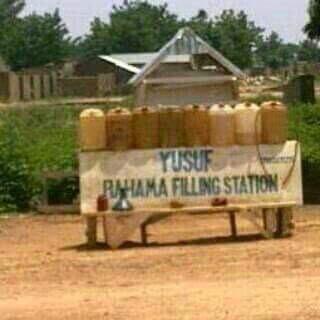
The fuel situation in Nigeria has made some people to discover their innate abilities. Look at Mallam Yusuf what he discovered of himself this period. What do you have to offer?
Paul Ryan: A Very Dangerous Man. Can His Theory Work?
Paul Ryan who talks about poor people and budgets sometimes, is
widely considered the face of compassionate conservatism. He's the lovable Republican, who cares in theory about poverty. What
Today’s enactment of the Department of Labor’s fiduciary rule, which
protects regular people from being swindled by financial advisors, is an
opportune time to reflect on the fact that Paul Ryan led the opposition to this rule,
meaning that he is in favor of regular people being swindled by the
financial industry. But his undercover fealty to corporate interests is
positively run-of-the-mill compared to the contrast between his
reputation (caring, concerned with the less fortunate, a believer in the redemption of government) and the reality of his budget proposals.
Among the small class of journalists who crunch numbers, it has never been a secret
that Paul Ryan’s economic plans are either ridiculously impossible or
ridiculously savage, depending on how you interpret his goals. Still,
that fact has not prevented the birth of a cottage industry of hagiography portraying Ryan as the Republican Party’s great uniter—“a man of faith and family values whose only real baggage is the suitcase he carries home each weekend to Wisconsin.”
How does that comport with the reality of Paul Ryan’s stated
priorities? The year before Ryan ran for Vice President, the
Congressional Budget Office released its analysis
of his dream budget—the budget that established him as a serious
Washington figure, the budget that represents what Paul Ryan would have
our federal government do it was up to him. This is a man whose name is
still, five years later, being tossed around
as Republican presidential nominee this year, despite the fact he is
not running.
This is a very powerful and popular national political
figure. Did you know, friends, that Paul Ryan would like to defund—to in
essence abolish—vast swaths of the federal government? Including the
parts of the federal government that take care of poor people, and of
public schools, and of a lot of other things used by just about
everyone.
The CBO’s report explains
the formula Ryan uses to slash the part of the federal budget where all
the useful stuff is, apart from Medicare and Social Security:
The path for all other federal spending excluding
interest—that is, for discretionary spending and mandatory spending
apart from that for Social Security and the major mandatory health care
programs—was specified by Chairman Ryan’s staff. The remaining part of
mandatory spending includes such programs as federal civilian and
military retirement, the Supplemental Nutrition Assistance Program,
unemployment compensation, Supplemental Security Income, the refundable
portion of the earned income and child tax credits, and most veterans’
programs. Discretionary spending includes both defense spending and
nondefense spending—in roughly equal amounts currently. That combination
of other mandatory and discretionary spending was specified to decline
from 12 percent of GDP in 2010 to about 6 percent in 2021 and then move
in line with the GDP price deflator beginning in 2022, which would
generate a further decline relative to GDP. No proposals were specified
that would generate that path.
What are the implications of such a spending reduction? The economist Dean Baker lays it out quite clearly. Bolding ours:
The analysis shows Ryan’s budget shrinking everything
other than Social Security and Medicare and other health care programs
to 3.5 percent of GDP by 2050. This is roughly the current size of the
military budget, which Ryan has indicated he wants to increase.
That leaves zero for everything else. Included
in everything else is the Justice Department, the National Park System,
the State Department, the Department of Education, the Food and Drug
Administration, Food Stamps, the National Institutes of Health, and just
about everything else that the government does.
Just to be
clear, CBO did this analysis under Ryan’s supervision. He never
indicated any displeasure with its assessment. In fact he boasted about
the fact that CBO showed his budget paying off the national debt.
Country music legend Merle HaggardDiesOn 79th Birthday
Country music legend Merle Haggard has died after battling double pneumonia according to his manager. Haggard was diagnosed with pneumonia last year and spent 11 days at
the Eisenhower Medical Center in Rancho Mirage early this year. He died
at home near Redding, CA on Wednesday morning.
He'd been battling back from the illness and even scheduled a string of concert dates with his pal Willie Nelson. They released an album, "Django and Jimmie" last year.
But last week Haggard canceled his shows for the month of April due
to his continuing efforts to recover. His manager said he was
weary from battling pneumonia for so long and had even predicted to
friends he would die on his birthday. His untimely death occurred today as he turned 79. He was inducted into the Country Music Hall of Fame in 1994. RIP, Haggard!
Peter Okoye and his new manager fly to Dubai for a solo performance
Peter Okoye, one of the members of the former group 'P-Square', his new manager Olatunde Michaels (far right),
his choreographer DonFlexx and others, this afternoon traveled to Dubai for a performance he has there scheduled for 7th
and 8th April, 2016. See more photos below
The Inspector General of Police, Mr Solomon Arase, has said that all Policemen
will henceforth undergo snap urine tests to detect any signs of drug
abuse before they can be issued firearms. He made this known at the launch
of drug testing kits and campaign against sudden death of police
officers in Abuja today April 6th.
“After an in-depth study, my team and I have found out that some of
these fatal cases could be due to mishandling of firearms by police
officers who are psychologically unfit to handle firearms at that time.
We have therefore decided that the medical assessment of persons we
recruit into the police Force will include a psychological assessment“he
said.
Caroline Danjuma responds to IG user who berated her for saying all men cheat
This was after Caroline Danjuma addressed her marriage and said all men cheat, an
IG user disagreed with her by posting the comment above. Here is Caroline's
reply to the user. See other comments below
Checkout those named in the Panama Papers, you'll be shocked
What do heads of state, FIFA execs, billionaires,
celebrities, and hundreds of their rich and powerful friends have in
common? Quite a few things, but here’s something specific:
They’ve all been named in the “Panama Papers,” the trove of 11.5 million
records that give insight into how the rich and powerful hide their
money abroad.
On Sunday, a consortium of newspapers broke the news
about the documents and records, apparently leaked from the Panamanian
law firm Mossack Fonseca, which specializes in setting up offshore shell
companies for its clients.
How it all happened:
The German paper Süddeutsche Zeitung obtained the documents, which reportedly include e-mails, PDFs, photos, and “excerpts of an internal Mossack Fonseca database,” dating from the 1970s up to this spring.
The paper says the encrypted files came from an “anonymous source,” who apparently
“wanted neither financial compensation nor anything else in return,
apart from a few security measures” for what came out to 2.6 terabytes
of data: the biggest leak of this kind of all time.
In a feat of impressive collaboration, coordinated by the International Consortium of Investigative Journalists (ICIJ), 100 news outlets publishing in 25 languages analyzed the records for a year before publication.
Contents of the documents:
The documents analyzed so far largely relate to off-shore bank
accounts established by Mossack Fonseca on behalf of its clients, which
are said to include politicians, celebrities, a ton of very wealthy
people, and quite a few criminals—both alleged and convicted.
There’s nothing illegal, per se, about opening a shell company or
using bearer bonds, and there are plenty of legitimate business reasons
to do so. But their use can also suggest the owner is trying to hide
funds or disguise the terms of a transaction like a divorce or real estate acquisition.
And indeed, that appears to be the case for a large number of Mossack Fonseca’s clients. Reports Süddeutsche Zeitung:
Clients can buy an anonymous company for as little as USD
1,000. However, at this price it is just an empty shell. For an extra
fee, Mossack Fonseca provides a sham director and, if desired, conceals
the company’s true shareholder. The result is an offshore company whose
true purpose and ownership structure is indecipherable from the outside.
Mossack Fonseca has founded, sold, and managed thousands of companies.
The documents provide a detailed view of how Mossack Fonseca routinely
accepts to engage in business activities that potentially violate
sanctions, in addition to aiding and abetting tax evasion and money
laundering.
According to
the ICIJ, some of the documents show that the banks, law firms and
middlemen involved “often failed to follow legal requirements that they
make sure their clients are not involved in criminal enterprises, tax
dodging or political corruption.” Other documents examined by the ICIJ
reportedly show offshore middlemen concealed suspect transactions.
According to Süddeutsche Zeitung, concealing the client’s
identity constituted the primary goal in “the vast majority” of cases.
Which makes sense—that’s why they go to Mossack Fonseca, which,
according to a 2015 audit, knew the true owners of just 204 of 14,086
companies it had incorporated in the Seychelles. According to the ICIJ,
the company once went so far as to remove paper records from its Nevada
offices to protect its clients from discovery.
The end result? A lot of money no one knows about.
The firm is denying everything: Mossack Fonseca co-founder Ramon Fonseca Mora tells CNN the
reports are false and claims several of the parties named in the leak
“are not and have never been clients of Mossack Fonseca.”
“Our services are
regulated on multiple levels, often by overlapping agencies, and we have
a strong compliance record,” the firm said.
“In
addition, we have always complied with international protocols” to
assure “that the companies we incorporate are not being used for tax
evasion, money laundering, terrorist finance or other illicit purposes,”
it added.
See those who have been implicated so far:
It’s not clear that the ton of bold-faced, high-profile names
reported as of today—at least 12 current or former heads of state, plus
hundreds of their wealthy friends, family, and countrymen—have done
anything illegal. But they also include at least 33 individuals and
companies blacklisted by the U.S. because of their business dealings
with entities like Hezbollah, North Korea, and Iran.
According to the
ICIJ, one of those companies has been accused of giving the Syrian
government fuel to use to bomb and kill its own citizens.
It’s going to take a while to parse out who owns what and whether
those transactions were legal or illegal, and more names are expected to
be made public in the weeks to come. According to
the ICIJ, the still-largely-anonymous client list contains a bevy of
prominent and powerful people that include “politicians, fraudsters and
drug traffickers as well as billionaires, celebrities and sports stars.”
Here are the big names we know so far:
Vladmir Putin
At least two of Putin’s closest friends are named in the documents,
which describe what appears to be a billion-dollar money laundering
ring.
Those two men are said to be concert cellist Sergei Roldugin, a
childhood friend of Putin’s and godfather to Putin’s daughter, and Yuri
V. Kovalchuk, the majority shareholder of Bank Rossiya, referred to by some as a “cashier” for Russian officials.
The Papers indicate Mossack Fonseca created a “complex, deliberately
convoluted network of offshore companies” for the men to funnel close to
two billion dollars through. Documents also show Roldugin’s involvement
with other companies—including the advertising firm founded by Mikhail
Lesin—who was found beaten to death in a Washington D.C. hotel.
Kovalchuk specifically denied the allegations to the New York Times, saying, “I’ve got an apartment, a car and a dacha... I don’t have millions.”
The Kremlin has so far, and will undoubtedly continue to, dismiss the papers as a smear campaign. Via CNN:
The Kremlin spokesman said it was clear the main target
of the reports was Mr Putin, as well as Russia’s political stability
ahead of parliamentary elections.
Dmitry Peskov dismissed the
investigation as insinuation and speculation, and suggested many of the
team of journalists behind it were actually former US state department
and CIA officials.
According to the ICIJ, documents also show Putin associates
“disguised payments, backdated documents and gained hidden influence
within the country’s media and automotive industries.”
Petro O. Poroshenko
Documents in the trove also indicate Petro O. Poroshenko, the
reformer president of Ukraine since 2014, lied about divesting his
assets before the election.
Mr. Poroshenko, a
tycoon with assets in television and a chocolatier before his entrance
into politics, pledged to divest himself of his holdings but instead
moved the assets into an offshore company in the British Virgin Islands,
according to the consortium’s reporting. It said that Mr. Poroshenko,
who has received political support from the United States, had not
disclosed the arrangement.
His financial advisors tell the
ICIJ he did not disclose the firm because it had no assets. Even so,
evidence indicates he was “scrambling” to find a copy of his utility
bill for the paperwork as Russia began its bloody invasion of the
country in 2014.
Icelandic Prime Minister, Sigmundur David Gunnlaugson
The documents indicate Iceland’s Prime Minister, Sigmundur David
Gunnlaugson, bought an offshore company called Wintris with his wife in
2007 which held millions of dollars in Icelandic bank bonds while the
country was in a financial crisis. Just a day before he would have had
to declare his 50% interest as a prerequisite of entering parliament, he
sold it to his wife—for the price of $1.
The company held bonds originally worth millions of
dollars in three giant Icelandic banks that failed during the 2008
global financial crash, making it a creditor in their bankruptcies.
Gunnlaugsson’s government negotiated a deal with creditors last year
without disclosing his family’s financial stake in the outcome.
He walked out of an interview yesterday when someone brought it up.
FIFA
Documents show Juan Pedro Damiani, a member of the FIFA ethics
committee, had business dealings with at least three men implicated in
the FIFA scandal last summer. FIFA’s ethics panel has since launched an
investigation.
Lionel Messi
The papers show the soccer player—who is currently under
investigation for tax evasion in Spain—owns at least one Panama company
called Mega Star Enterprises Inc.
Marianna Olszewski
Finally—an American.
One wealthy client, US millionaire and life coach Marianna Olszewski,
was offered fake ownership records to hide money from the authorities.
This is in direct breach of international regulations designed to stop
money-laundering and tax evasion.
An email from a Mossack
executive to Ms Olszewski in January 2009 explains how she could deceive
the bank: “We may use a natural person who will act as the beneficial
owner… and therefore his name will be disclosed to the bank. Since this
is a very sensitive matter, fees are quite high.”
Jackie Chan
Documents show Jackie Chan owns at least six companies established by the firm.
Hosni Mubarak
Documents show Mossack Fonseca was fined $37,500 for money laundering
after it set up a company for Mubarak’s son but “failed to identify the
connection” even after the former Egyptian president and his son were
both charged with corruption.
At the time, an internal review reportedly concluded, “our risk assessment formula is seriously flawed.”
Muammar Gaddafi
Details surrounding Gaddafi’s involvement are scant, but the BBC reports family members or associates held secret offshore accounts created by Mossack Fonseca.
President Bashar al-Assad
Rami Makhlouf, a cousin of al-Assad—described by the U.S. as a “poster boy for corruption”—was implicated in the papers, the Guardian reports, and while al-Assad is not specifically mentioned, the documents reveal “any foreign company seeking to do business in Syria had to be cleared by Rami.”
According to the Guardian’s analysis, Mossack Fonseca helped
the Makhlouf family register its Syrian companies in the British Virgin
Islands, and kept him as a client despite sanctions imposed against him
by the United States and his involvement in the Syrian civil war.
The documents show, however, that the Panamanian firm
continued to work with the Makhloufs, and in January 2011 it rejected
the advice of its own compliance team to cut ties with the family as the crisis in Syria began to unfold.
Documents
show a Mossack Fonseca compliance officer wrote: “I believe if an
individual is found on a sanction list then this is a serious red flag
and we should make every effort to disassociate ourselves from them.”
Though
Mossack Fonseca was not legally bound to comply with US sanctions, it
had an obligation to react to EU measures imposed in May 2011 and
extended to the British Virgin Islands (BVI) in June of that year. It
took until September 2011 before the partners finally agreed to resign
from Makhlouf’s companies.
Mauricio Macri
Argentina’s current president was reportedly a director and vice
president of an offshore company managed by Mossack Fonseca at the same
time he served as mayor of Buenos Aires. Documents appear to show he did
not disclose these assets. A spokesperson tells the ICIJ he never
personally owned shares of the firm.
Nawaz Sharif
Documents show the firm established companies that hid real estate holdings of Sharif’s children.
Ilham Aliyev
The firm established Panamanian foundations and shell companies for
the family of Azerbaijan’s president to hide their ownership in gold
mines and London real estate.
Xi Jinping
The family of Chinese president Xi Jinping—who rails against the
“armies of corruption”—obtained offshore companies through Mossack
Fonseca. The documents also indicate offshore holdings of the families
of at least seven other members of China’s Politburo Standing Committee.
David Cameron
According to the Guardian,
Cameron is now facing scrutiny over an offshore fund established by his
late father, Ian, which avoided ever paying taxes in the UK. Cameron
denies receiving any benefits from the offshore account.
“In terms of my own financial affairs, I own no shares. I have a
salary as prime minister and I have some savings, which I get some
interest from and I have a house, which we used to live in, which we now
let out while we are living in Downing Street and that’s all I have.”